
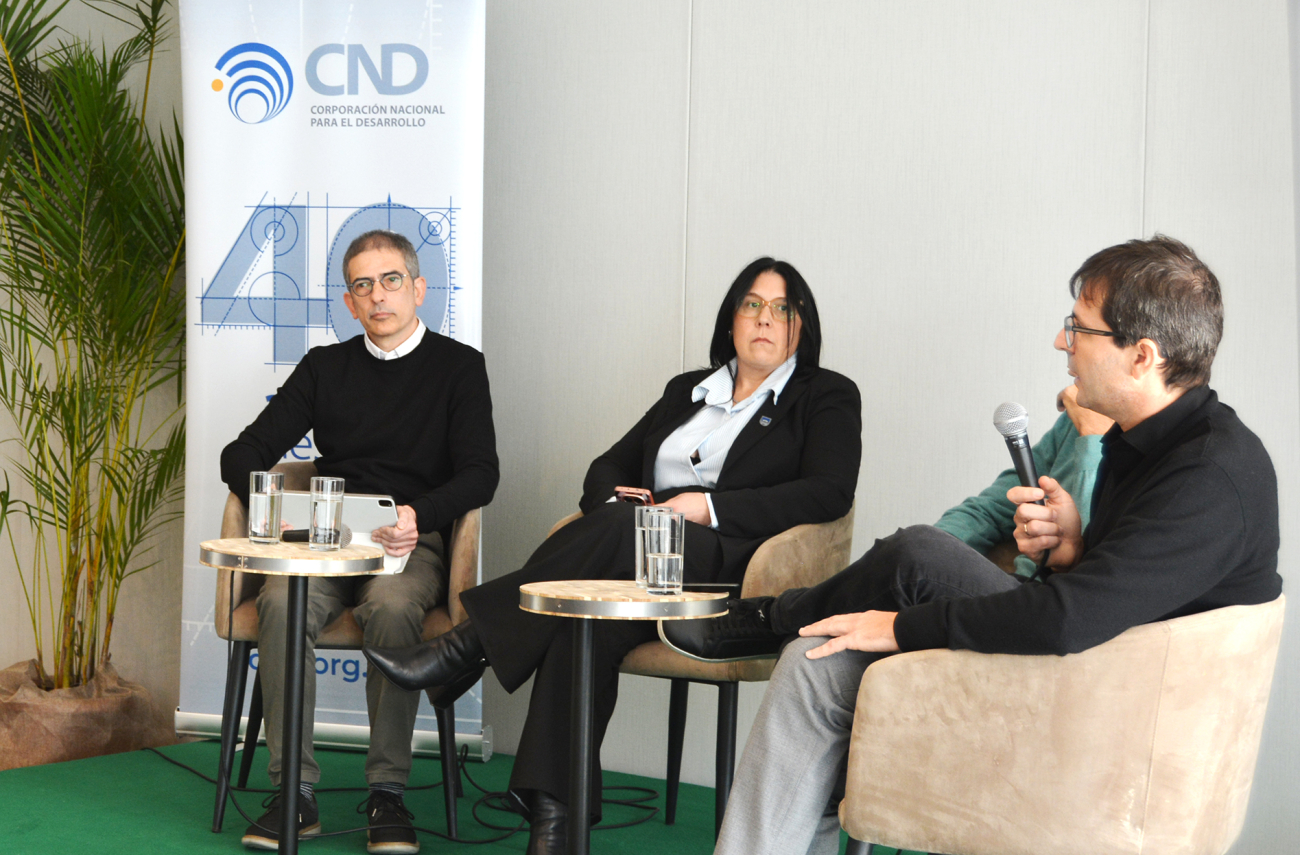
CND participated in the Uruguay Sustainable Expo 2026 with a panel discussion focused on wood construction, based on a specific case study: the new annex of UTEC’s Northern Regional Technological Institute in Rivera, the first public educational building in Uruguay constructed with a mass timber structure.
The event, organized by CND, brought together representatives from public administration, academia, and industry to discuss how public infrastructure can become a space for innovation, sustainability, and national productive development. The panel featured presentations by Architect Maurizio Rodríguez Torriano, CND’s Manager of Technical Architectural Oversight; Technician Cyntia Da Silva, coordinator of the Wood Technology program at Udelar’s Rivera campus; and Economist Sebastián Bianchi, technical advisor in the Industrial Policy division of the National Directorate of Industries at the Ministry of Industry, Energy, and Mining (MIEM).
During the event, CND presented the UTEC Rivera expansion project as an example of sustainable public architecture and highlighted its role as trustee of the UTEC Trust, through which it is responsible for contracting, managing, and providing technical and financial oversight of the projects. In this case, UTEC acts as the settlor and CND as the trustee, coordinating the execution of a project that incorporates new wood construction technologies.
The project was developed with the participation of specialized national companies: Arboreal, responsible for the design and production of the Mass Timber CLT and GLT panels; Enkel Group, in charge of assembling those components; and José Cujó S.A., as the construction company.
CND’s presentation focused on lessons learned on-site and the value of incorporating industrialized systems into public infrastructure. Building with Mass Timber allows for the high-precision production of components in a workshop, dry assembly, accelerated construction phases, and reduced rework on site. It also incorporates wood from Uruguayan forest plantations, integrating environmental sustainability with the local supply chain.
One of the central elements was the life-cycle analysis conducted to compare the traditional system with the hybrid system incorporating Mass Timber. According to the results presented, the hybrid alternative resulted in an estimated reduction of 235,815 kg of CO₂ equivalent, representing a 53.8% decrease in total emissions from the structural project.
The roundtable also provided an opportunity to broaden the perspective on the challenges Uruguay faces in incorporating more wood into construction. UDELAR highlighted the importance of promoting specialized training for professionals in design, structural analysis, sustainable architecture, energy efficiency, responsible management of forest resources, and environmental regulations. It was also noted that the Wood Technology degree program, offered in Rivera, was developed in response to the growth of the forestry and timber industry and provides skills applicable to sustainable wood construction.
For its part, MIEM presented the industrial opportunities associated with wood construction in a country with a well-established forestry sector, where more than 90% of its plantations are certified, and a growing ecosystem of companies involved in this type of construction. The presentation also addressed the need to advance in the development of specialized products, the training of specialized professionals, standards, and greater public-private coordination.
The event concluded with a panel discussion and a Q&A session with the audience, during which participants exchanged perspectives on digitalization, sustainability, training, market barriers, and opportunities to strengthen wood construction in Uruguay.
For CND, the UTEC Rivera experience confirms that sustainability in public infrastructure depends on several factors that must work together: the technology used, the quality of the design, project management, and evidence-based decision-making. Participation in Expo Uruguay Sostenible provided an opportunity to showcase how a public project can simultaneously serve as educational infrastructure, a showcase for technology, and a contribution to national industrial development.
